



Weekly update
21 January
Azerbaijan now wants to achieve two goals, and one has already been achieved - the checkpoint. It is not formalized, but in reality there are people standing in the Lachin corridor, who have to be asked if people and cargo can pass through. Baku only wants to formalize it, Director of the Caucasus Institute Alexander Iskandaryan told news.am on the Power Factor. Baku's second immediate goal is a peace treaty where the Karabakh issue would be spelled out as an internal task for Azerbaijan. It is a step towards the withdrawal of peacekeepers, because if Karabakh is an internal matter, why do we need peacekeepers, he added. The expert noted that Azerbaijan has a whole bouquet of goals in general, and Karabakh without Armenians is the general goal. There is also a goal of the so-called Zangezur corridor, the territory of Armenia itself. Therefore, even if they open the Lachin corridor, the strategy of pressure on the Armenians of Nagorno-Karabakh will not disappear. Aliyev is probing red lines, testing Russia for weakness. This is also a conflict between Moscow and Baku. The negotiation process between them is rather intense, and it is very closed, he said.
https://news.am/eng/news/740636.html
20 January
The Armenians of Nagorno-Karabakh (natively called Artsakh) are struggling to survive a merciless economic and physical blockade, instigated and orchestrated by Azerbaijan in December of last year in what seems to be its last-ditch effort to eradicate or expel every last Armenian from their ancestral lands. In line with globenewswire.com yet to understand how and why this crime against innocent civilians is happening today is to go back to the infamous morning of September 27, 2020, which is where the new wartime documentary Invisible Republic begins. When Artsakh resident Lika Zakaryan woke up to an all-out attack by enemy forces across the entire line of demarcation with Azerbaijan, she wasted no time to take steps to wake up the world to the plight of her people. For each of the ensuing 44 days of the brutal military aggression, she summarizes her experience in a personal online diary. Each entry is another opportunity to deconstruct Azerbaijan’s rogue tactics to not only defeat Armenians militarily but also terrorize and destroy innocent civilians. “We have moved up the release of the film and made it available globally to bring attention to Artsakh at its existential moment,” says Garin Hovannisian, the film’s director and founder of Creative Armenia. “As Azerbaijan’s blockade of the Lachin Corridor creates a deepening food, health, and humanitarian crisis for the 120,000 Armenians now trapped in Artsakh, we hope Lika’s story can help make her invisible republic more visible to the world.”
https://www.globenewswire.com/news-release/2023/01/20/2592714/0/en/INTENSE-LIVE-ACTION-WAR-DOCUMENTARY-RELEASED-IN-PARTNERSHIP-WITH-AGBU-FORESHADOWS-CURRENT-HUMANITARIAN-CRISIS-IN-NAGORNO-KARABAKH.html
19 January
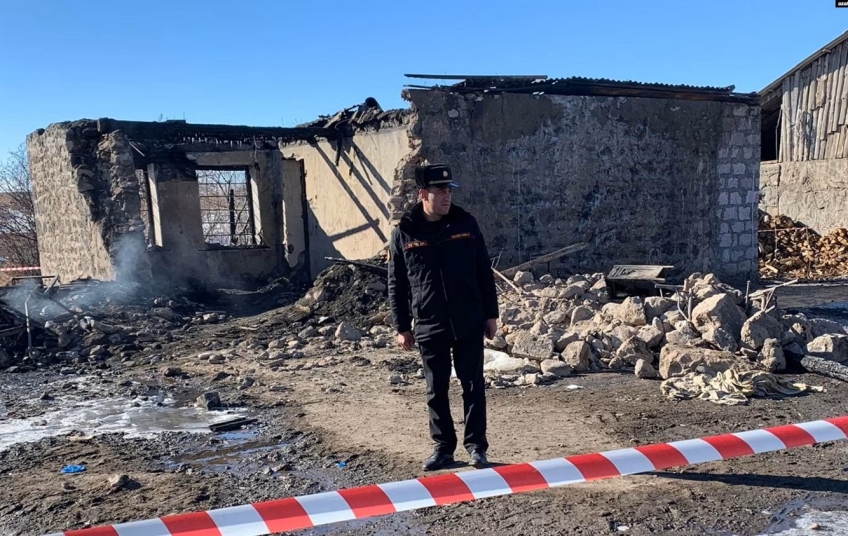
Fifteen soldiers were killed and three others seriously injured in what authorities said was a major fire that broke out at a military barracks in Armenia early on Thursday, azatutyun.am reported. According to the Armenian Defense Ministry, the fire erupted overnight at the barracks of an engineer-sapper company in a military unit in Azat, a village in eastern Gegharkunik province, some 110 kilometers east of Yerevan. Citing the “preliminary” findings of military investigators, Prime Minister Nikol Pashinian and Defense Minister Suren Papikian blamed it on a serious violation of fire-safety rules. Pashinian said an officer of the unit used a large amount of gasoline to start a fire in a woodstove heating the barracks. He said the Armenian army’s General Staff strictly banned the use of gasoline and other highly inflammable liquids for such purposes in a written order issued as recently as on December 21. “Primitive compliance with this order would have prevented the accident,” Pashinian added during a weekly session of his cabinet.
https://www.azatutyun.am/a/32230356.html
18 January
Azerbaijani government-backed protesters blocking Nagorno-Karabakh’s land link with Armenia stopped and entered on Tuesday night Russian military vehicles carrying Karabakh Armenian children separated from their families. The 19 teenagers had travelled to Armenia to attend a robotics course. According to azatutyun.am like more than a thousand other Karabakh residents, they were unable to return home due to the road blockade that began on December 12. The Azerbaijani side eventually agreed to let Russian peacekeepers escort the schoolchildren back to Karabakh. However, a Russian military convoy transporting them was reportedly made to stop and wait for hours at the blocked section of the sole road connecting Karabakh to Armenia. According to Karabakh officials, masked Azerbaijanis forced their way into two military trucks to film the children seated there before letting the convoy proceed to Stepanakert. The children were intimidated by the intrusion, with one of them fainting as a result, the officials said. One of the children and a Karabakh official who accompanied their group on the trip to and from Armenia confirmed that on Wednesday.
https://www.azatutyun.am/a/32229216.html
17 January
As the Artsakh blockade imposed by Azerbaijan entered its second month with no end in sight, the Armenian government increased the level of criticism of Russia. According to armenianweekly.com the new phase of anti-Russian rhetoric was launched by the secretary of the Security Council, who, in late December 2022, publicly claimed that Russia was using the closure of the Lachin Corridor to force Armenia to join the union state of Russia and Belarus and open an “exterritorial corridor” to Azerbaijan’s Nakhichevan exclave via Syunik province. Kremlin spokesman Dmitry Peskov denounced his comments as provocative and insisted that Russian officials have never told Yerevan to open the land corridor for Azerbaijan or join the Russian-Belarusian union state. While refraining from directly accusing Russia of participating in the closure of the Lachin Corridor, Prime Minister Nikol Pashinyan criticized Russia and its peacekeepers for becoming a “silent witness” to the depopulation of Nagorno-Karabakh. During his January 10, 2023 press conference, Pashinyan stated that if it becomes clear that, due to objective or subjective reasons, Russia is unable to fulfill its commitments, it should ask the UN Security Council to either grant an international mandate to the Russian military contingent or send a new multinational peacekeeping mission to Nagorno-Karabakh.
https://armenianweekly.com/2023/01/17/can-armenia-become-a-new-georgia/
16 January
On January 16, the European Court of Human Rights sent an urgent notice to the Committee of Ministers of the Council of Europe to monitor Azerbaijan's implementation of its December 21, 2022 decision to unblock the Lachin Corridor, Armenpress was informed from the official Facebook page of the representative of Armenia on International Legal Matters. On December 22, 2022, Azerbaijan applied to the European Court, demanding the annulment of the decision to apply an interim measure. At the same time, Azerbaijan demanded to apply interim measures against Armenia. In response, the Office of the Representative for International Legal Matters sent regularly updated information to the European Court in December 2022 and January 2023 about the dire humanitarian situation in Nagorno-Karabakh around the Lachin Corridor. At the same time, the Office of the Representative for International Legal Matters requested the European Court to send an immediate notification to the Committee of Ministers of the Council of Europe regarding Azerbaijan's failure to comply with the decision of the European Court of December 21, 2022. The European Court, taking into account the arguments presented by the parties, rejected Azerbaijan's claims in full today, leaving the decision of December 21, 2022 in force. The European Court also rejected Azerbaijan's request to apply an interim measure against Armenia.
https://armenpress.am/eng/news/1101807.html
15 January
A group of Israeli academicians, journalists and activists from Israel have addressed a letter to Eli Cohen, the new Israeli minister of foreign affairs, asking him to help prevent a humanitarian catastrophe in Artsakh. Armradio.am reads: “We are academics and artists in varied fields of endeavor, whose activities bring us in various ways into contact with the situation in the South Caucasus, its history and culture. We are writing to ask you to approach two states, both friendly to Israel, Azerbaijan and Russia, which have the ability to prevent a grave humanitarian crisis that may, at any time, exact a high price in human suffering and life,” the signatories write. Reminding that the Lachin corridor – the only road connecting the Republic of Artsakh to Armenia – has been blocked by Azerbaijanis since December 12, 2022, they write: “Due to this continuing blockade, not only are vital supplies prevented from reaching Nagorno Karabakh, but also thousands of its residents are unable to travel between Karabakh and Armenia. The inhabitants of this enclave suffer daily from a lack of basic food-stuffs, medicine, and energy for light and heat in this cold winter season. The situation is in danger of degenerating and threatening the lives of these 120,000 inhabitants.
https://en.armradio.am/2023/01/16/israeli-academicians-journalists-and-activists-address-a-letter-to-foreign-minister-regarding-the-lachin-corridor/
14 January
In line with hetq.am the Artsakh government reports that 1,102 children scheduled to receive medical treatment in Armenia have been prevented from doing so because of the Lachin Corridor’s ongoing closure. According to 847 suffer from congenital heart defects, 93 from bronchial asthma, 66 from periodic diseases, 80 from epilepsy and 16 from diabetes. Ten Artsakh doctors have been prevented from returning from Armenia, leading to a shortage of physicians in the country.
https://hetq.am/en/article/152094