


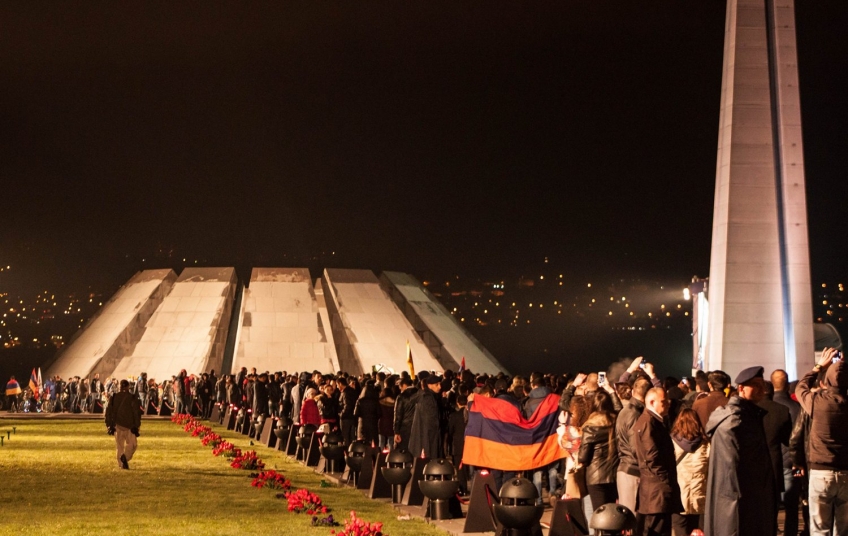

Today is April 24, and the Armenian people, for the 106th time, will head to Yerevan's Tsitsernakaberd Memorial Complex to pay homage to the memory of 1.5 million innocent victims of monstrous massacre, Armenian genocide and Great deprivation, perpetrated in Ottoman Turkey in 1915. April 24 is not just a day of mourning. It is a day of remembering, demanding, redefining and reconstructing.
Every year, approaching the Memorial Complex in silence and laying flowers at the monument to the eternal fire of our holy martyrs, the Armenians reflect for a moment, trying to understand in their minds’ eye how the terrible disaster in the early 20th century became possible, what lesson it gave to the Armenian people and the whole progressive humanity, who, by and large, were unconcerned about the great pain of the Armenian nation, and which are the main message of that day addressed to the people of Armenia and Diasporan Armenians?
It is evident that this day is perceived differently in Armenia and in the Diaspora, and that is natural. In the traditional Diaspora, the Armenian Genocide has a noble mission of national preservation, which continues to protect our compatriots abroad as Armenians and as bearers of the Christian faith. There is no such problem in Armenia, but there are other dangers and challenges, the confrontation of which is becoming especially urgent nowadays.
For some of the participants in the first war in Artsakh, the war was an opportunity to revenge their ancestors’ death, for others, it was a message to be strong in defending their rights, so that such cases would not happen anymore. And today, after the 44-day Artsakh war, people received a different message. Many people mistakenly think that genocidal actions were possible only in the bloody 20th century, now the world has changed, humanity is civilized, and genocides remained in the past.
But is that so? Of course no. Few will claim now that the times of genocides are over. The fact is that the 21st century is not free from such dangers either, we see what is happening, for example, in Syria. The future of our region seems alike with destabilization, deportations, proxy or mediated wars, religious fanaticism and a war instigated by a major power which does not itself become involved, at the expense of others’ lives.
The events of the past are evaluated differently in each period, according to the realities of the period. The past, perceptions, dangers and their solutions are re-evaluated. If decades ago we paid tribute to the memory of the victims of the tragedy of the past, now it is possible that it may happen in the future. In this respect, we re-evaluate the past today compared to the present realities, with the perspective of tomorrow.
Perhaps this is the most important question that each of us should ask ourselves when climbing Tsitsernakaberd. After all, to redefine the past means to draw conclusions from the past, to change the ideas about the world order and to create the future, taking them into account.